In this article
A large total can look reassuring while answering the wrong question. A corporate cash view might include several entities, selected bank accounts and only one reporting currency. It might also mix a recently updated account with another that last refreshed yesterday. Before asking whether the total rose or fell, establish what the total is a total of. A useful first deliverable is a short scope card that can travel with the report, so the next reader does not have to reconstruct its meaning from filters.
Give the view a precise job
Decide whether the view supports a morning observation, a forecast starting point or an explanation of yesterday’s movement. These jobs overlap, but their evidence requirements differ. A morning observation may need an explicit freshness warning. A forecast starting point needs a reliable boundary between observed balances and projected activity. An explanation needs comparable opening and closing populations. Calling all three a cash report does not remove these differences. Give the report a descriptive title and a sentence explaining its intended use.
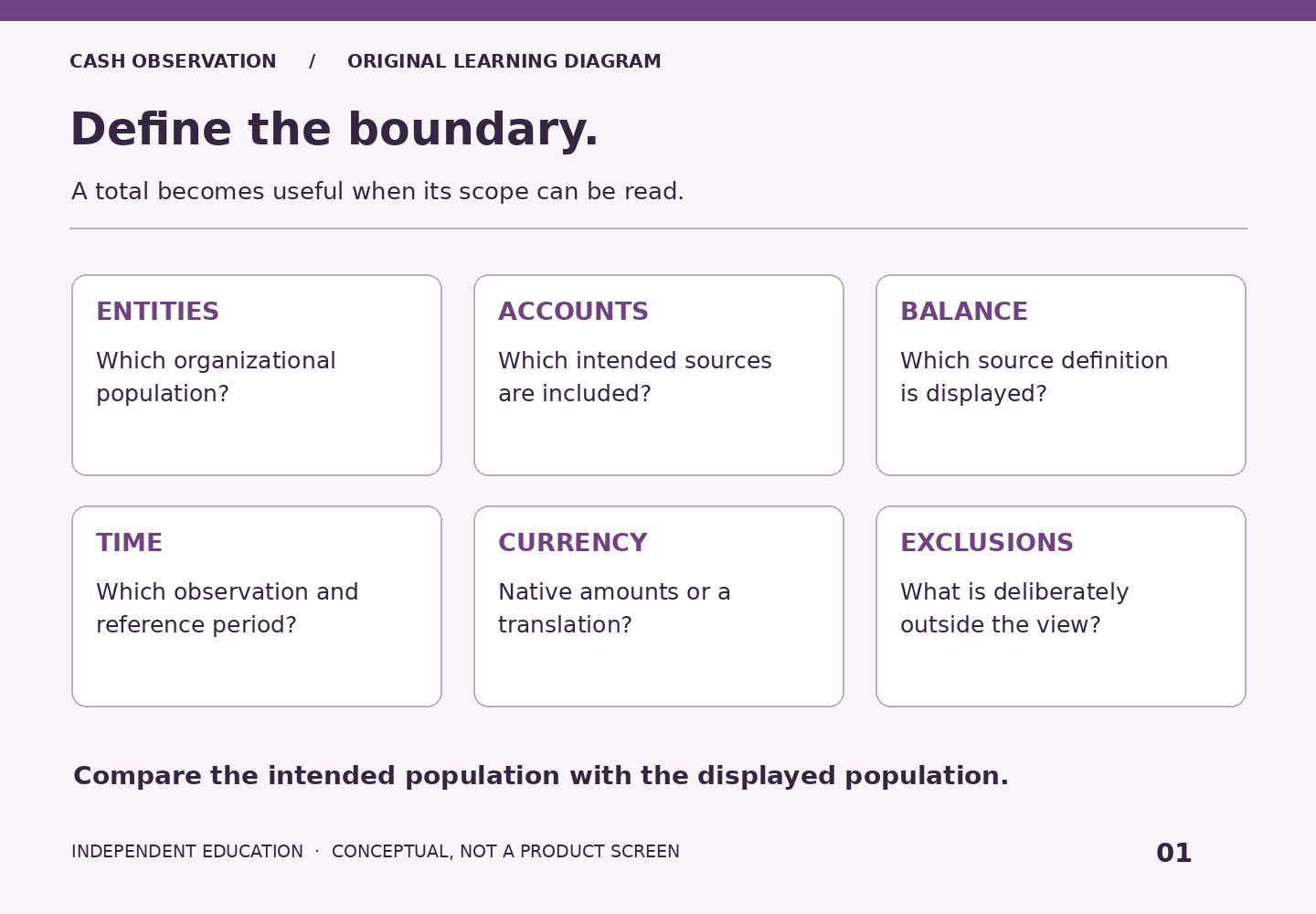
Start the scope card with six fields: included entities, included accounts, balance definition, time reference, currency treatment and exclusions. These are not six new software settings. They are six questions for the report owner to answer using the actual system and internal documentation. If a field cannot be established, write that uncertainty beside the total rather than substituting a plausible answer. A reader should be able to distinguish a deliberate exclusion from an unexplained absence.
Separate organizational coverage from technical connection
An account can be connected to a reporting system without belonging in a particular view. Conversely, an account can belong in the intended population while its data is unavailable. Maintain a distinction between the intended account inventory and the rows currently visible. A comparison of those two sets makes missing coverage discoverable. Merely counting displayed accounts can conceal a substitution, where one expected account disappears and an unintended account takes its place.
In a fictional example, a group’s daily view contains its operating subsidiary and service company. A newly acquired distribution entity has not yet been included in the reporting population. The displayed total is internally consistent for the two included entities, but it is not a group-wide total. The useful correction is a scope label and an ownership question about the new entity. Quietly estimating its balance and adding it to the same observed total would blur evidence types and make later comparisons harder.
Make balance meaning visible
Do not assume that two columns named balance use the same definition. Ask the accountable owner which source field is being shown, whether any adjustments are applied and what the timestamp represents. Keep the provider’s definition with the report documentation. A display can describe a bank-reported amount without establishing that the entire amount is unrestricted or available for a particular corporate action. The interpretation must respect the organization’s actual account and entity constraints.
If a report includes a management adjustment, show the observed source amount and the adjustment separately where the reporting policy allows. Explain why the adjustment exists and who reviews it. This preserves a route back to evidence. It also prevents an adjustment from becoming an invisible permanent part of the opening balance, which could cause future readers to count the same expected movement twice.
Publish the boundary with the number
A practical scope note might say that this is an observation of the approved operating-account population, translated using the documented reporting convention, with one account awaiting a refresh. That statement does not need sensitive account identifiers in a broad audience report. Keep detailed inventories in approved internal storage and share only the level of detail each audience is authorized to receive. The scope note should link internally to the controlled definition rather than reproduce confidential bank records.
At the next review, compare the current scope card with the previous version before explaining movements. A changed entity population can create an apparent increase that is really a reporting-boundary change. A changed currency convention can produce another artificial comparison. Record these changes explicitly and decide whether the prior period needs a comparable restatement under your internal reporting process. The goal is not an impressive single total. It is a total whose limits the reader can understand and whose population the owner can reproduce.
Scope and source note
This is an original, independent educational method. It is not a Trovata operating manual, an account diagnosis, or a recommendation to move, borrow or invest money. The official source below supplies product context only; the examples and checklists are our own. Verify actual coverage, permissions and configuration with your organization and provider.
Continue the observation
Freshness is a dimension, not a badge · A scenario is a different question, not a new actual · An internal transfer can change the picture without changing the group