In this article
A report created this morning can contain information from several different moments. The time on the exported file describes the file, not necessarily the age of every source record inside it. Treat freshness as a property of each relevant input, then explain how those inputs support the overall view. This is especially important when several banks, entities or reporting processes contribute to a consolidated observation. One recently updated row should not lend its apparent freshness to every other row.
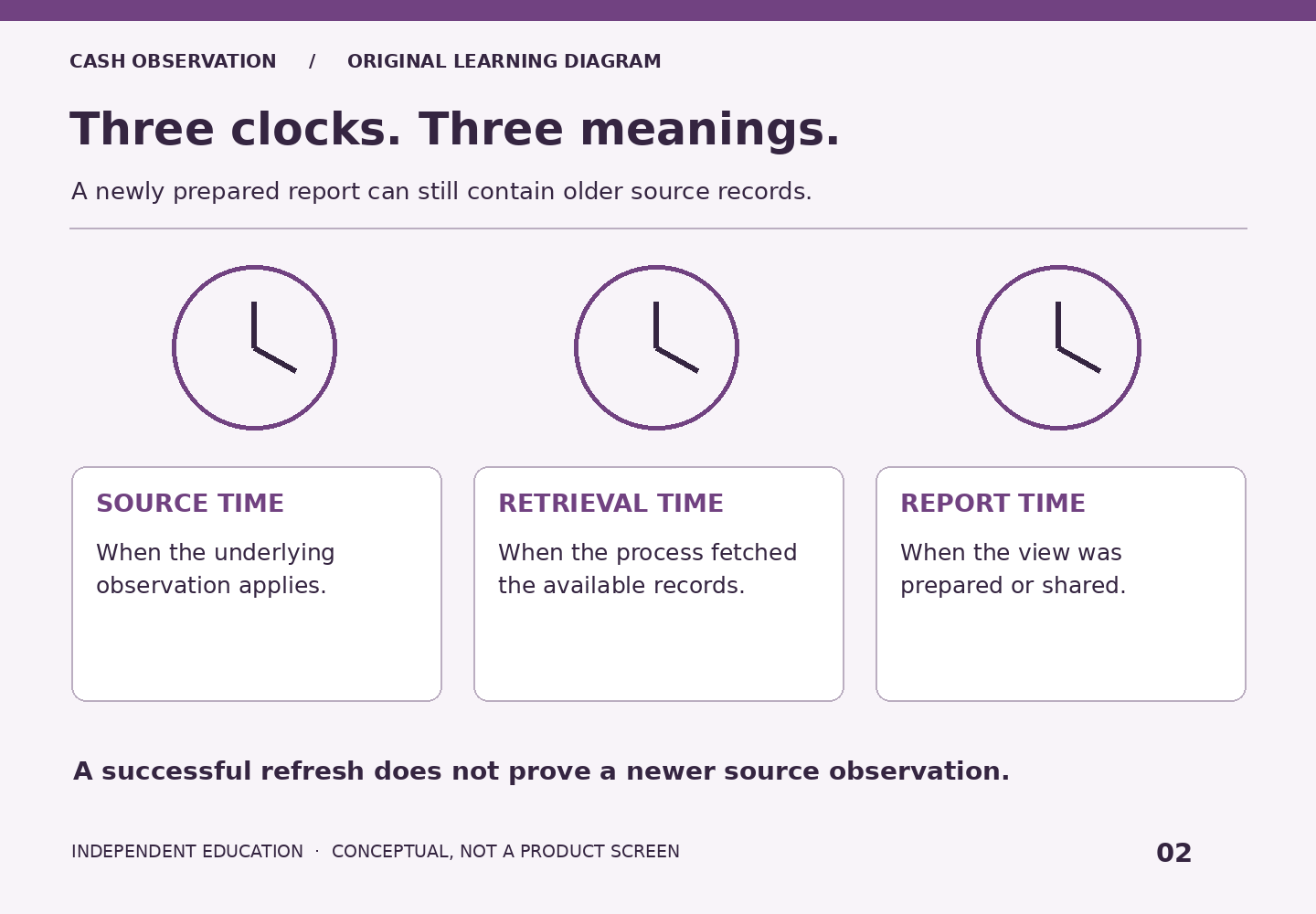
Read three clocks separately
The first clock is the source record’s effective or observation time, using the terminology actually supplied by the bank or source system. The second is the time the reporting process retrieved or refreshed the data. The third is the time someone prepared or published the report. These times may be close together, but they are not interchangeable. A successful retrieval can return unchanged prior information; a later report publication does not make that information newer.
For a controlled report, document which clock each timestamp represents and the relevant time zone. Avoid silently converting a date-only source into a precise timestamp. If the source supplies only a business date, retain that limitation. When source definitions are unclear, ask the data owner to resolve the meaning before using the timestamp as evidence of intraday coverage. Precision in formatting cannot replace precision in the underlying record.
Build an exception view
Rather than giving every account a generic green status, identify the inputs whose age or completeness needs review for the report’s intended job. The organization should define the relevant review expectations. This educational publication cannot set a universal age threshold for all banks or decisions. A prior-day report and an intraday observation can reasonably require different checks. The important control is that the expectation is explicit and the exception is visible.
A useful exception entry contains the affected scope, last established source time, last retrieval result, known limitation and accountable follow-up owner. A missing value is not a zero balance. A failed refresh is not proof of no activity. An unchanged value is not automatically evidence of a broken connection. Each condition calls for a different question, and collapsing them into one error label makes the next action less clear.
Work through a fictional morning
Imagine a fictional treasury reader preparing a morning observation. One bank’s available records are current to the prior business day; another source has a later intraday observation. The reader can display both if the approved reporting method allows, but should identify the differing reference times. Calling the sum a synchronized current position would claim more than the evidence supports. The first review question is whether the mixed-time view is suitable for the decision under consideration.
Suppose a second retrieval returns the same records. The retrieval event can be recorded as successful without marking the source time as newer. If the bank normally provides a different update pattern, the process owner can investigate. If the pattern is expected, the report may simply retain its clearly stated limitation. Either way, the reader should not manufacture activity, infer a service outage from a single unchanged balance, or change production connection settings merely to obtain a fresher-looking label.
Explain stale information without erasing it
Older information may still be useful as a reference if its age is obvious. Keep it distinguishable from a current observation and avoid substituting it silently for unavailable inputs. If a report uses a carry-forward convention, document that convention and identify the affected rows. A carry-forward value is an assumption about presentation, not a newly observed balance. This distinction helps the next reviewer understand whether a movement reflects real activity or the eventual arrival of delayed data.
When preparing a stakeholder summary, state the practical consequence of the limitation. For example, explain that one segment remains based on the last available source records and requires confirmation before the intended analysis can be completed. Do not merely write data issue and leave the reader to infer severity. Use the organization’s approved escalation process for material gaps, and keep detailed records out of unapproved channels.
Recheck the report after recovery
When newer data becomes available, compare it with the previously published observation and assess whether a correction or annotation is needed. Preserve the earlier report’s reference point so the history remains understandable. A refreshed view is not a reason to erase the fact that earlier readers used a limited view. Close the exception only after confirming that the intended population, source time and report interpretation now align, and record who made that determination.
Scope and source note
This is an original, independent educational method. It is not a Trovata operating manual, an account diagnosis, or a recommendation to move, borrow or invest money. The official source below supplies product context only; the examples and checklists are our own. Verify actual coverage, permissions and configuration with your organization and provider.
Continue the observation
Keep actuals and estimates on opposite sides of the line · Explain forecast variance before scoring it · Match forecast detail to the horizon