In this article
A scenario asks what the modeled cash view would look like under a specified set of conditions. It does not establish that those conditions will occur. That distinction can disappear when an attractive chart is circulated without its assumptions. Give every scenario a clear identity and keep it separate from observed activity and from the current approved baseline. The reader should be able to tell which question the scenario answers before interpreting its result.
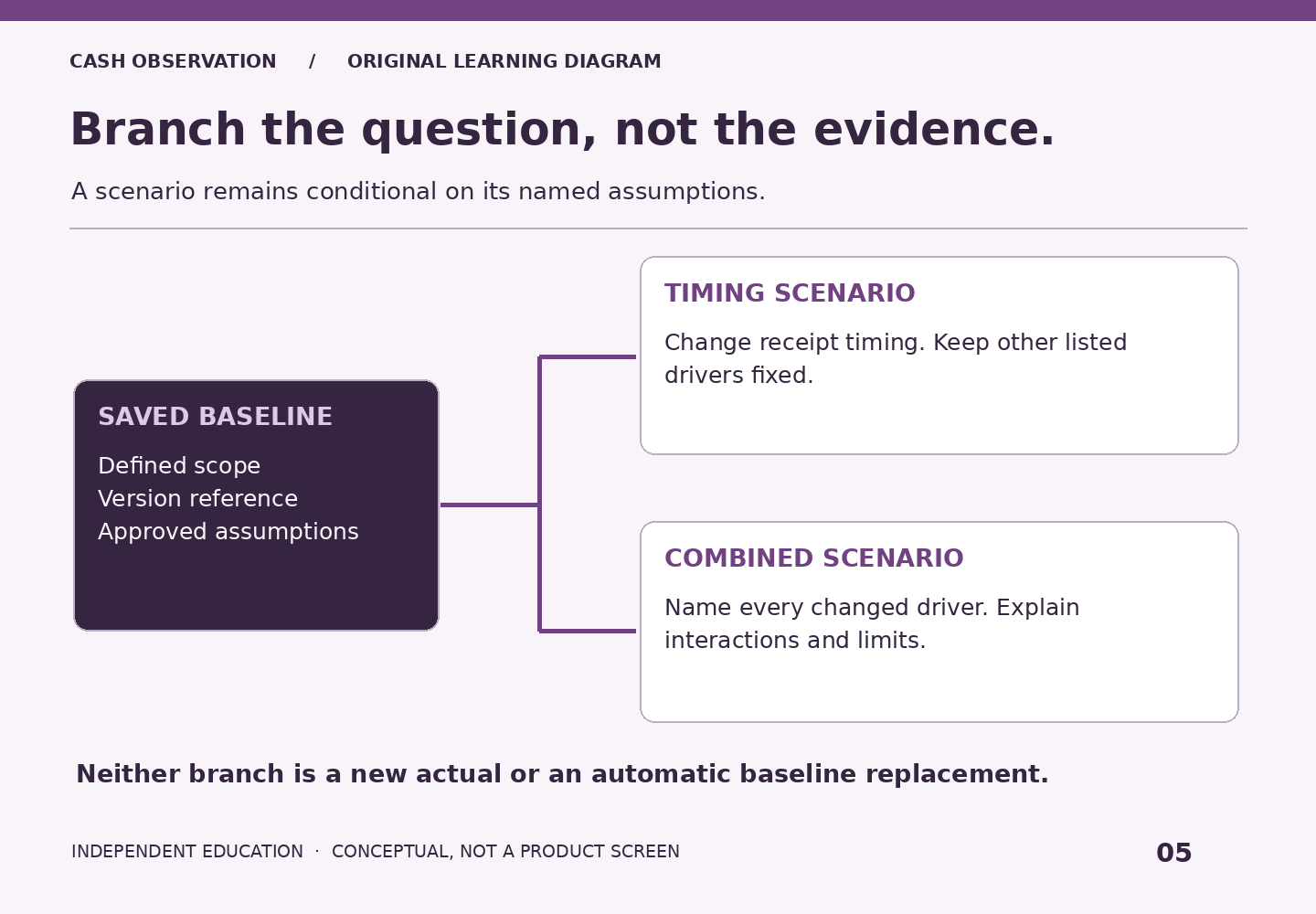
Give the scenario a passport
A compact scenario passport contains a name, purpose, baseline reference, changed assumptions, unchanged assumptions, time horizon and owner. The name should describe the condition being explored rather than imply a guaranteed outcome. A label such as later receipts is more informative than bad case when timing is the only changed driver. If multiple drivers change, state them explicitly so readers do not attribute the entire difference to one cause.
The baseline reference matters because a scenario built from an older population may not be comparable with a newly revised forecast. Record the exact approved version or other controlled reference used in the organization. If the baseline later changes, decide whether the scenario should be rebuilt or retained as a historical exercise. Do not silently relabel the old scenario as though it reflects the new starting point.
Start with one interpretable change
For an educational exercise, changing one driver at a time makes the resulting difference easier to discuss. A fictional team might compare the same planned activity under an unchanged receipt schedule and a later receipt schedule. The exercise can reveal where timing matters within the model. It does not estimate the probability of the delay, establish a funding need or authorize any action. Those judgments require the organization’s evidence and decision process.
After reviewing the single-driver exercise, a team may decide to explore combinations. At that point, record how the assumptions interact. Two changes may overlap rather than simply add together. A delayed receipt and a lower receipt estimate can affect the same underlying population. Without a scope check, the scenario could accidentally count the same adverse condition twice. Conversely, assuming independent behavior can understate a relationship that deserves attention.
Preserve the unchanged conditions
Reviewers often focus on what changes and overlook what stays fixed. A scenario may hold exchange-rate conventions, entity coverage or planned outflows constant for clarity. Those fixed conditions are part of the scenario’s meaning. If they are unrealistic for the intended question, the scenario may still be a useful sensitivity exercise, but it should not be presented as a comprehensive picture of what would happen in the real organization.
Write a short limitation statement beside the result. Explain which relevant factors are outside the exercise and which relationships have not been tested. Avoid a generic disclaimer that adds no interpretive help. A useful limitation tells the reader why a seemingly precise difference should be understood as conditional. It also creates a sensible next question for the model owner instead of inviting overconfident action from an isolated number.
Compare like with like
Use the same reporting periods, scope and currency convention when comparing scenario outputs. If those foundations differ, explain the mismatch before discussing the numerical difference. A cumulative view and a period-only view can tell different stories. Label the measure so readers do not mistake one for the other. If a chart compresses the time axis, ensure the associated explanation still identifies the periods relevant to the question.
Separate the modeled effect from any management response. An exercise may explore a condition without assuming a corresponding borrowing, investment or transfer decision. If a response is modeled, make it a distinct assumption with the required internal approval and an explanation of its dependencies. This article does not recommend a response. It helps readers see whether a response was included in the scenario they are being asked to interpret.
Close with a decision question
A scenario review should end with a bounded question, such as which assumptions require better evidence or which time periods deserve closer monitoring. Record what the exercise taught and what remains unknown. Do not promote a scenario to the baseline merely because its output attracted attention. Any baseline change should follow the organization’s review process and preserve the earlier version. The value of a scenario is a clearer conversation about conditions, not a claim to predict them.
Scope and source note
This is an original, independent educational method. It is not a Trovata operating manual, an account diagnosis, or a recommendation to move, borrow or invest money. The official source below supplies product context only; the examples and checklists are our own. Verify actual coverage, permissions and configuration with your organization and provider.
Continue the observation
Explain forecast variance before scoring it · Match forecast detail to the horizon · Evaluate a cash-visibility platform with a question set