In this article
A cash forecast combines information with different levels of certainty. Some records describe activity already observed in a source; others describe expected activity that may change in timing or amount. The challenge is not to eliminate estimates. It is to keep estimates recognizable and to know when observed evidence replaces them. Without that boundary, a forecast can include an expected receipt and its actual counterpart as though they were two independent inflows.
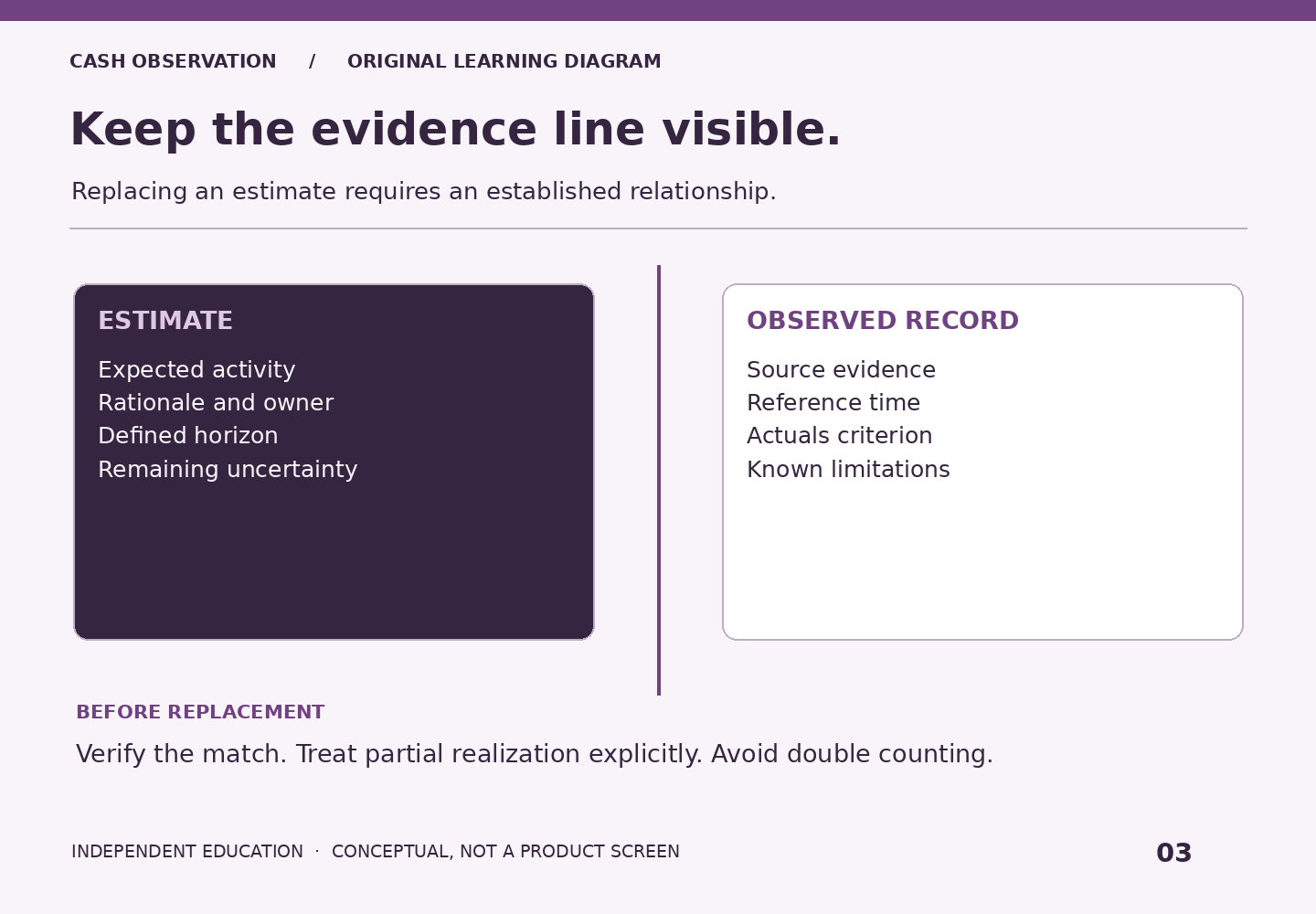
Define the evidence classes
Use labels that describe evidence rather than confidence theater. An observed bank record, an approved internal plan and a modeled expectation are different classes even if all three are considered reliable for their purpose. Record the source, reference period and owner of each class. Avoid calling every imported row an actual simply because software has loaded it. An imported planning file can still contain estimates, and an observed source record can still require interpretation or correction.
The boundary should specify which event qualifies a movement to enter the actuals population in your reporting process. That event depends on the source definitions and the organization’s method. This article does not prescribe a universal bank status or accounting rule. It asks the owner to define the criterion and make it available to reviewers. An undocumented boundary forces each reviewer to invent one, which makes comparisons unstable.
Write the replacement rule before the cutover
A replacement rule explains how an estimate is associated with a later observed record and what happens to the original estimate. It should account for partial realization, changed timing and unmatched evidence. Use approved internal references when available, rather than relying solely on similar amounts or descriptions. Similarity can suggest a candidate match without proving that two records represent the same economic movement.
In a fictional exercise, a planned customer receipt is included in a weekly forecast. A bank record later appears that may correspond to part of the receipt. Removing the whole estimate could understate the remaining expectation; leaving the whole estimate could double count the observed portion. The reviewer needs evidence of the relationship and a documented treatment of the remainder. The answer cannot be derived from the word received alone.
Preserve the earlier forecast
Save the forecast version that was actually available at the earlier decision point through the organization’s approved versioning process. Rebuilding yesterday’s forecast using today’s information creates a misleading benchmark. When actuals arrive, compare them with the earlier estimate on the same scope and time basis. Keep a separate current forecast for today’s planning. These two versions serve different jobs: learning from the past and supporting a current view.
A compact cutover note can identify the period being closed, the actuals coverage, outstanding matches, remaining estimates and reviewer. It should also explain whether the current period contains a mixture of actual and forecast components. A mixed period is not inherently wrong, but it needs a clear rule. Readers must know whether a remaining projected amount describes the entire period or only the activity not yet observed.
Treat unmatched records as questions
An actual with no corresponding estimate can represent an unplanned movement, a classification mismatch, an incomplete forecast population or a matching problem. An estimate with no actual can represent timing change, cancellation, missing data or a forecast error. These possibilities need investigation before a conclusion. The useful review output is a categorized exception with evidence and an owner, not an automatic accusation that the forecast was wrong.
Avoid changing historical labels just to improve an accuracy score. If the original categorization was genuinely incorrect, preserve the correction history and explain its effect. A learning process becomes less useful when the baseline is adjusted until it appears to have predicted what happened. The same principle applies to deleting inconvenient unmatched items. Documented exclusions may be appropriate under the reporting method, but they must remain visible and consistently applied.
Finish with a readable bridge
At review time, explain the transition from the saved estimate to observed activity in plain language. Identify which components were realized, which moved to a later period and which remain unresolved. This bridge is often more useful than a single percentage because it points to the assumptions that deserve attention. The aim is a forecast that can be challenged constructively, with a preserved record of what was known and a clear account of what changed.
Scope and source note
This is an original, independent educational method. It is not a Trovata operating manual, an account diagnosis, or a recommendation to move, borrow or invest money. The official source below supplies product context only; the examples and checklists are our own. Verify actual coverage, permissions and configuration with your organization and provider.
Continue the observation
Build a forecast assumption register people can challenge · Read a multicurrency cash view in two layers · Reconcile the cash view before explaining the story