In this article
Every forecast contains judgments, even when it begins with well-organized historical data. The question is whether those judgments are visible enough for someone else to examine. An assumption register is a companion to the forecast that records the reasoning behind selected projected movements. It does not need to become a warehouse of every minor detail. Start with assumptions whose uncertainty or consequence could meaningfully change how readers interpret the forecast.
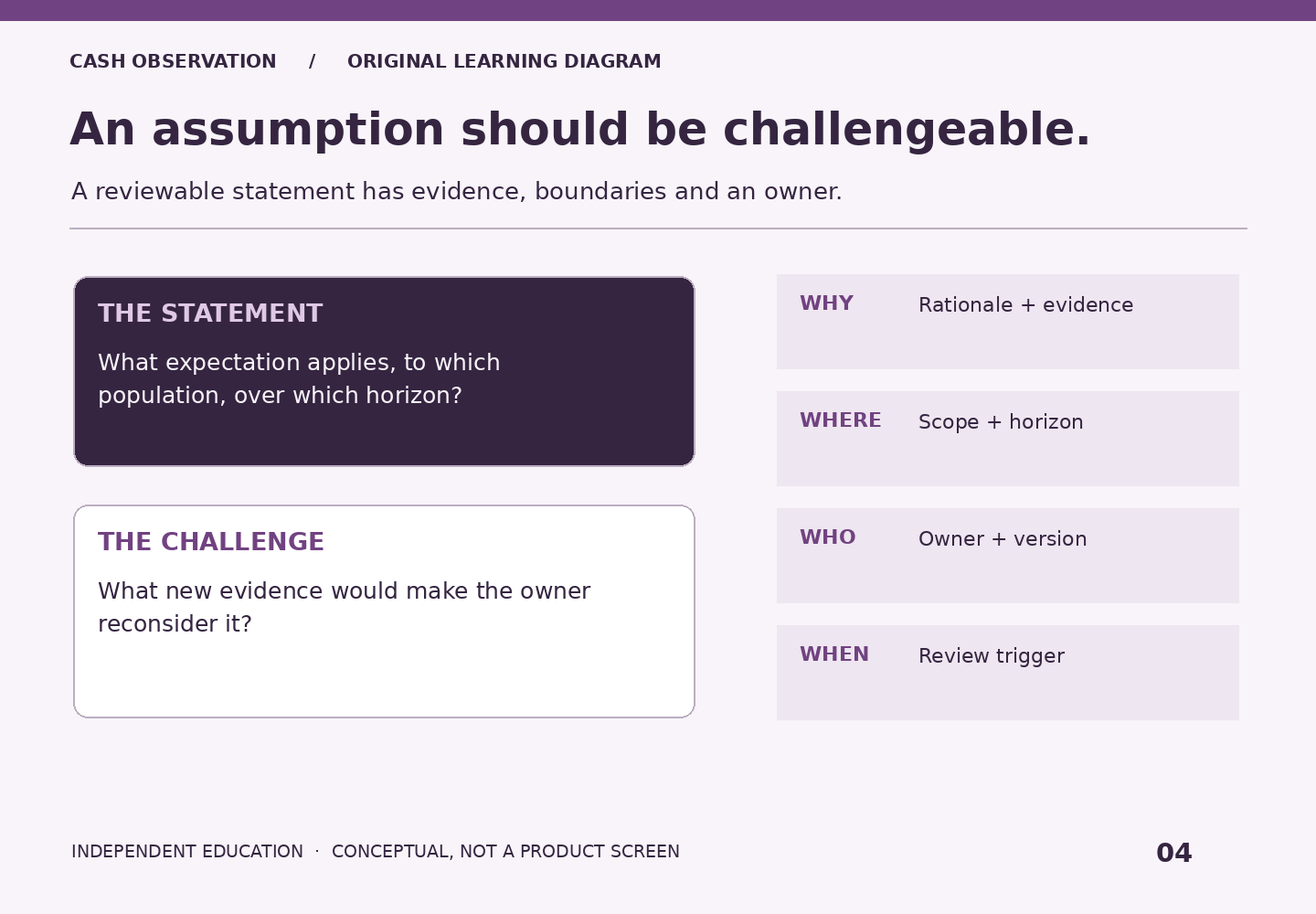
Make each assumption a testable statement
An entry such as collections look normal is hard to review because normal is undefined. A more useful statement identifies the driver, affected population, horizon and condition under which the assumption applies. It explains what evidence would support the statement and what evidence would challenge it. This does not require exposing customer-level information to a broad audience. Detailed support should stay in approved internal systems with appropriate access.
Use seven fields: assumption statement, rationale, evidence reference, scope, owner, review trigger and version. The statement describes the modeled relationship or expectation. The rationale explains why it was selected rather than merely repeating it. The evidence reference makes the claim traceable. Scope prevents the assumption from spreading into unrelated entities or periods. Ownership and a review trigger ensure the entry can change when circumstances do.
Separate facts from judgments
A signed internal schedule, a source record and a recurring historical pattern do not carry the same meaning. Identify what has been observed and what has been inferred from that observation. For example, a history of a certain timing pattern can inform a working expectation without guaranteeing the next occurrence. If an assumption depends on an operational team’s plan, record the approved source and its current version rather than attributing certainty to an informal conversation.
In a fictional organization, the forecast owner uses a recurring collection pattern as the starting assumption for an upcoming period. The commercial team reports a change affecting part of the customer population. The register should show whether that new information changes the whole assumption or only a defined subset. A broad manual adjustment with no scope note would make the forecast harder to explain and could obscure which driver actually changed.
Add a review trigger instead of an expiry ritual
A review date is useful, but some assumptions need earlier attention when a relevant event occurs. A trigger might be a changed operational schedule, newly available actuals or a source refresh that invalidates an earlier limitation. The trigger should describe the condition and the responsible owner. It should not be a vague instruction to keep an eye on things. A reviewer needs to know what evidence to look for and where the decision belongs.
If a trigger fires but the relevant evidence is still incomplete, retain the uncertainty explicitly. Do not automatically replace the assumption with the most optimistic or pessimistic alternative. The appropriate response may be a separate scenario, a narrower scope or an annotated unresolved item under the organization’s process. The register records the decision and its basis; it does not make the decision on behalf of authorized treasury or finance staff.
Invite disagreement in a structured way
A useful challenge names the assumption, presents contrary evidence and describes the affected period or population. It does not require the challenger to rebuild the entire model. Ask reviewers which conditions would have to be true for the current assumption to remain reasonable. Then ask whether those conditions can be established from the available information. This makes disagreement about evidence and scope rather than about personal confidence.
Keep competing assumptions separate until the owner resolves the issue. Combining incompatible judgments into an unexplained average can make the result look precise while concealing the disagreement. If the approved approach uses a weighted treatment, document the method and why it is appropriate. This publication does not recommend any specific modeling technique for a particular business. It provides a way to make the chosen technique inspectable.
Keep the register usable
At each forecast version, identify assumptions that were added, changed, retained or retired. Preserve prior versions so an actuals review can refer to what was believed at the time. Remove clutter from the active view by moving resolved historical entries into the approved archive, rather than losing their history. A good register helps the next reviewer locate a small number of important judgments quickly and understand what evidence could change them.
Scope and source note
This is an original, independent educational method. It is not a Trovata operating manual, an account diagnosis, or a recommendation to move, borrow or invest money. The official source below supplies product context only; the examples and checklists are our own. Verify actual coverage, permissions and configuration with your organization and provider.
Continue the observation
A scenario is a different question, not a new actual · An internal transfer can change the picture without changing the group · Hand off a cash report without losing its caveats